
Vision
To embed quality-related activities deeply within the academic culture and ensure ongoing improvement in both academic and administrative performance.
Mission
The IQAC strives to play a key role in achieving practical quality standards and upholding them for the holistic advancement of the institution. Its goal is to establish optimal assessment methods to ensure quality is maintained and to enhance policy implementation.
Objectives
To formalize and implement quality standards for the
- To serve as a catalyst for the comprehensive enhancement of academic and administrative functions within the
- To cultivate a culture of enthusiasm for knowledge acquisition, skill development, and excellence in teaching, learning, and research among all
- To advocate for self-evaluation, accountability, autonomy, and transparency through established quality procedures.
- To provide interventions and guidance to departments as necessary to elevate quality
- To streamline the integration of the institution’s diverse activities and institutionalize exemplary
Contributions of IQAC:
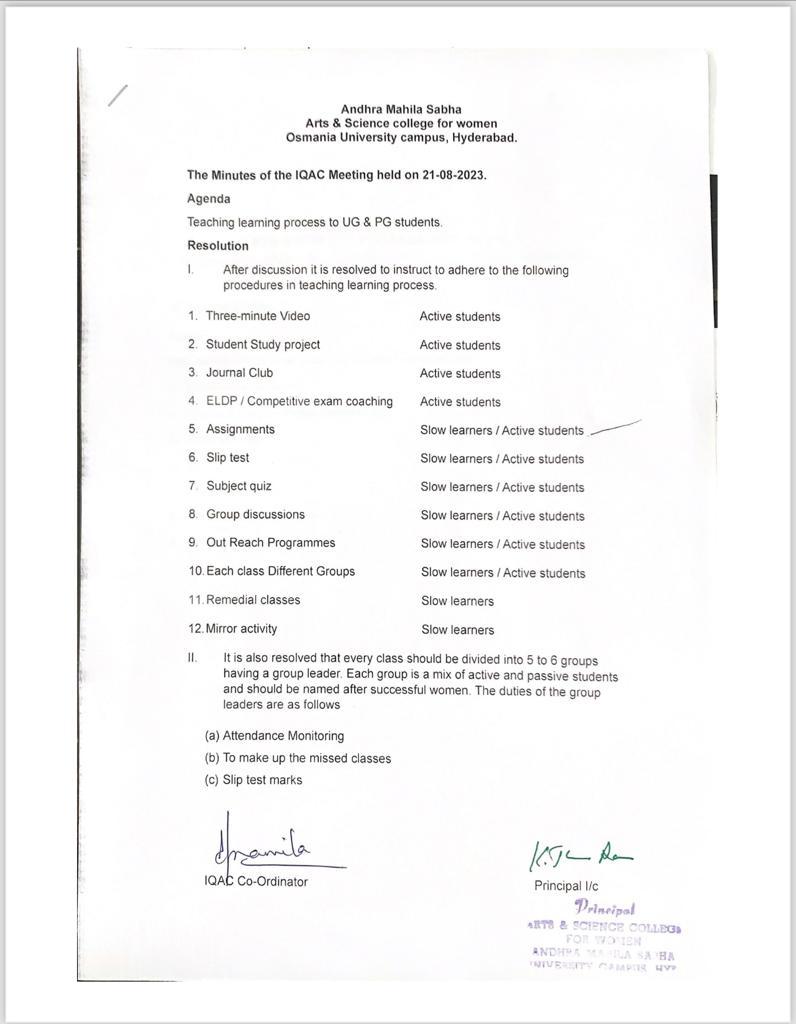
A primary focus of the IQAC has been to elevate the teaching-learning process. Through systematic evaluations and reviews, the cell has encouraged faculty members to embrace innovative pedagogical
techniques and integrate technology into their teaching methods. This emphasis on adopting learner-centered approaches has enriched the academic experience for students and ensured alignment with evolving educational paradigms.
Beyond the classroom, the IQAC has spearheaded initiatives to enhance the institutional framework and operations. By establishing clear policies and procedures, the cell has fostered transparency and efficiency in administrative functions. Furthermore, the implementation of robust feedback mechanisms has facilitated stakeholder engagement, ensuring their satisfaction and input in institutional decision-making.
Central to its mission, the IQAC has monitored and assessed learning outcomes to gauge the attainment of educational objectives. Through rigorous data analysis, the cell has identified areas for improvement and implemented targeted interventions to enhance student learning experiences and academic achievement.
The impact of the IQAC’s efforts is evident across various dimensions of institutional functioning:
The contributions of the IQAC are visible in various aspects of institutional functioning:
- Enhanced Academic Rigor: The IQAC has promoted a culture of academic excellence by introducing skill development courses and by encouraging faculty members to engage in scholarly activities such as conduction and participation in national & international seminars and conferences, to pursue professional development opportunities, and maintain high standards of teaching and research.
- Improved Student Support Services: The IQAC has facilitated the development of comprehensive student support services to address the diverse needs of learners through ward counselors, psychologists and legal cell Career guidance provided by the placement cell, women’s empowerment cell and Academic cell; and support for internships, training & extracurricular activities, by the placement cell & Sports Authorities.
- Strengthened Quality Assurance Mechanisms: The IQAC has strengthened internal quality assurance mechanisms through the implementation of rigorous assessment and accreditation processes every year by conducting Academic audit thoroughly, on a NAAC seven point This benchmarks performance against standards, driving continuous improvement.
- Evolving Teaching Methodologies: Teaching methodologies have evolved over time from traditional blackboard teaching to interactive digital Peer groups, modular teaching, and online learning platforms have enhanced student engagement and participation.
- Enhanced Stakeholder Engagement: The IQAC fosters collaboration and engagement with stakeholders through participatory decision-making processes and regular communication channels, involving eminent academicians and industrialists apart from alumni and the present Stakeholders’ voices are valued in institutional planning and decision-making.
Overall, the IQAC at Andhra Mahila Sabha Arts and Science College for Women has made significant contributions to institutionalising quality assurance strategies and processes. Its efforts have resulted in continuous improvement in teaching and learning practices, operational efficiency, and overall institutional effectiveness.
Best Practices
- The orientation for the First-Year students.
- Student feedback is collected
- Orientation for the newly appointed staff is conducted through seminars and meetings in a phased manner.
- The department with the BOS members discusses best practices at the departmental level.
- At the management level aided by the Academic Council and the Governing Body formulates the policy for the college as a whole.
- The Academic coordinator of the college meets periodically to review the academic activities of each department in order to ensure quality enhancement.
- Best practices, irrespective of where they originate are recorded at the IQAC and the ideas get disseminated across every function of the institution ensuring that best practices are internalized and get woven into the very fabric of the institution.
The IQAC of our college was started on 6th September 2005. The then Chairperson was Smt.A. Sita Mahalakshmi and Dr. Lalitha Kameshwari as its Coordinator.
IQAC Coordinators: Name of IQAC Coordinator
| 2005-2010 | Dr.Lalitha Kameshwari HOD, Economics |
| 2010-2011 | Dr.G.L.K.Durga HOD, Reader in Commerce |
| 2011-2014 | Dr.G.N.Bhagya Rekha, Reader in Zoology |
| 2014-2021 | Dr.K.Karuna Devi, Associate Professor in English |
| 2021- June 23 | Dr.P.Rajya Lakshmi, Associate Professor in English |
| June, 2023- till Date | Dr.A.Pramila , Associate Professor in Botany |
Accreditation Details
| S.No | Cycle | Grade | CGPA | Year of Accreditation | Validity period |
| 1 | 1st Cycle | B+ | – | 2005 | 5 years
28.02.2005 to 27.02.2010 |
| 2 | 2nd Cycle | B | 2.93 | 2013 | 5 years
23.03.2013 to 22.03.2018 |
| 3 | 3rd Cycle | B | 2.21 | 2018 | 5 years
02.11.2018 to 02.11.2023 |
| 4 | 4rd Cycle | B++ | 2.81 | 2024 | 5 years 20th December,2024 to 19th December, 2029 |
Activities
-
- Prof. K. Karuna Devi, Principal I/c, attended the Two-Day National Consultative Workshop on MBGL Framework for Autonomous and Affiliated Colleges under NAAC Reforms held on 11th–12th August 2025, organized by NAAC, Bengaluru.
Report - The Internal Quality Assurance Cell (IQAC) of Andhra Mahila Sabha Arts and Science College for Women organized a Guest Lecture on the Union Budget 2026–2027 on 7th February 2026.
Report - The Internal Quality Assurance Cell (IQAC) of Andhra Mahila Sabha Arts & Science College for Women, Hyderabad, organized an Orientation Programme for Teaching and Non-Teaching Staff on 17th and 18th June 2026 with the objective of fostering professional excellence and strengthening institutional effectiveness.
Report
Details of the previous year’s AQAR submitted to NAAC after the latest Assessment and Accreditation by NAAC.
2022-2023 26.05.2023 2021-2022 23.03.2022 2020-2021 06062021 2019-2020 22.01.2020 2018-2019 22.01.2020 2017-2018 28.11.2018 2016-2017 30.07.2017 2015-2016 30.07.2016 2014-2015 30.07.2015 2013-2014 30.06.2014 2013-2012 30.06.2013 2011-2012 30.06.2012 - Prof. K. Karuna Devi, Principal I/c, attended the Two-Day National Consultative Workshop on MBGL Framework for Autonomous and Affiliated Colleges under NAAC Reforms held on 11th–12th August 2025, organized by NAAC, Bengaluru.
Quick Links
Dowloads
26th, 27Th & 28Th IQAC Minutes
Strategy Development and Deployment
33 IQAC Meeting Minutes
34 IQAC Meeting Minutes
35 IQAC Meeting Minutes
36 IQAC Meeting Minutes
37 IQAC Meeting Minutes
38 IAQC Meeting Minutes
39 IAQC Meeting Minutes
service rules
Strategic plan and deployment 2023-2024
IQAC Minutes
IQAC Minutes-iqacmeeting28aug2023
4.4.2 Procedures and policies for maintaining and utilizing physical, academic and support facilities
7.3.1 Institutional Distinctiveness
Feed Back report 2022-23
Research policy
SOFTSKILLS/LANGUAGE & COMMPUNICATION SKILLS/LIFE SKILLS/AWARENESS OF TRENDS IN TECHNOLOGY
Annual Report 2019-2020
Annual Report 2020-2021
Annual Report 2021-2022
Annual Report 2022-2023
Annual Report 2023-2024
Annual Report 2024-2025
Best Practices 2022-2023
Best Practices 2021-2022
Best Practices 2020-2021
Best Practices 2019-2020
Best Practices 2018-2020
The performance of the institution in an area distinct to its priority and thrust